
The Bounce Black Team
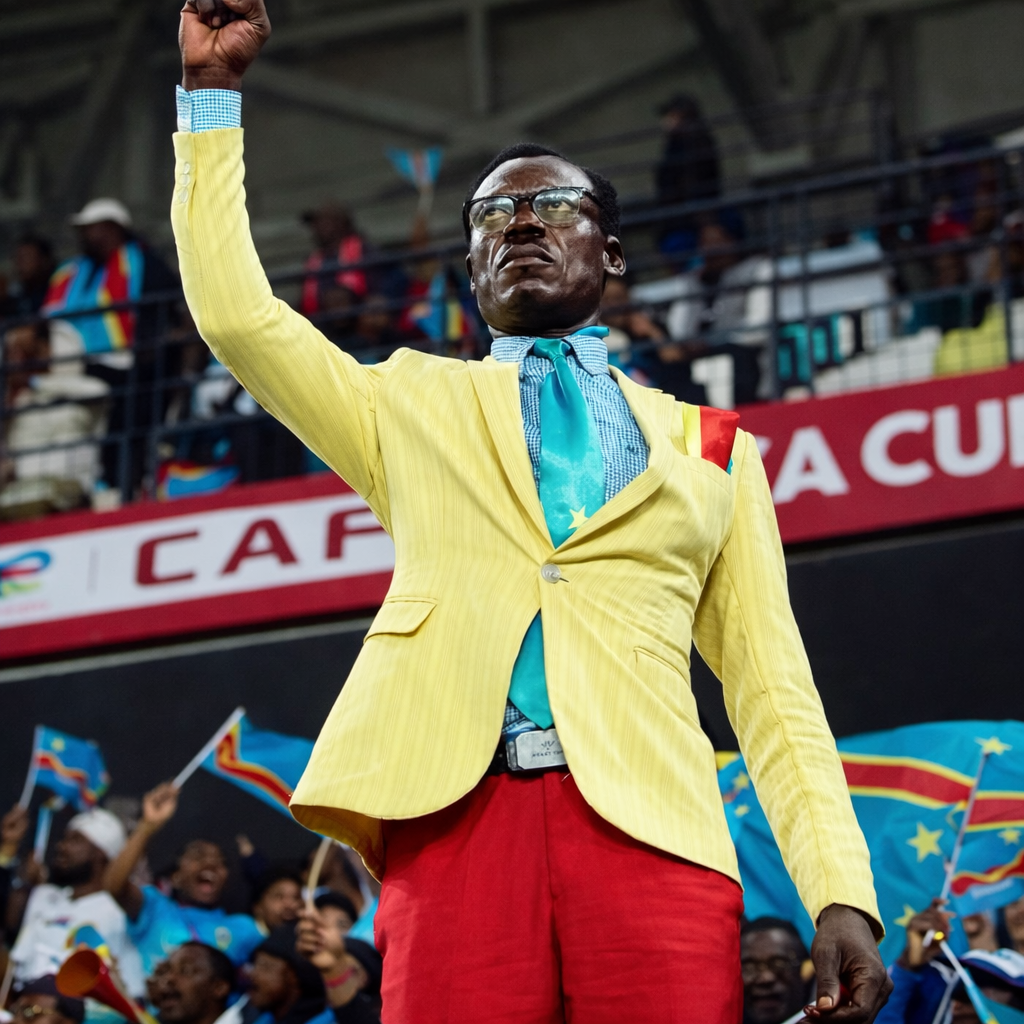
During the Africa Cup of Nations (AFCON), a tribute to Patrice Lumumba briefly cut through the noise of competition and celebration.
Michel Nkuka Mboladina, a Congolese national football supporter, stood as a statue in honour of Lumumba during the Congolese team’s matches at this year’s AFCON.
It was a powerful reminder that African sport, culture, and joy are inseparable from African history. That includes its struggles, betrayals, and unfinished liberation.
Photo: Mo Le Conquérant
Who is Patrice Lumumba?
Patrice Lumumba was not only the first Prime Minister of the Democratic Republic of Congo. He was a pan-African visionary who understood that political independence without economic, cultural, and psychological freedom was a continuation of colonialism by other means.
Lumumba believed Africa deserved dignity. He rejected foreign control disguised as partnership and spoke openly about the violence, theft, and dehumanisation of colonial rule. He insisted that Congolese resources should benefit Congolese people, and that Africa’s future should be shaped by Africans themselves.
For this clarity, and this courage, he was assassinated.
Assassination as a Tool of Control
Lumumba’s murder was not an anomaly. It was part of a wider, deliberate pattern that, arguably, quietly continues today.
Across the continent, leaders who dared to imagine an Africa free from extraction, dependency, and external domination were removed, often violently, when their visions became inconvenient to global power.
These assassinations were not only about silencing individuals. They were about interrupting movements, destabilising futures, and sending a warning to anyone who might follow.
The Leaders Who Paid the Ultimate Price
We honour Patrice Lumumba alongside other pan-African leaders whose lives were cut short because their values threatened entrenched systems of exploitation.
- Thomas Sankara (Burkina Faso) believed leadership should be modest, accountable, and rooted in service. He prioritised women’s liberation, environmental sustainability, mass literacy, and national self-reliance. Sankara demonstrated that African leadership could be ethical, visionary, and uncompromising in its commitment to the people.
- Amílcar Cabral (Guinea Bissau and Cape Verde) was both a revolutionary organiser and a profound political thinker. He emphasised political education, cultural pride, and the importance of unity between intellectuals and working people. Cabral taught that liberation was not only about territory, but about consciousness.
- Eduardo Mondlane (Mozambique) combined scholarship with activism, believing independence required long-term investment in education, collective leadership, and institution-building. He envisioned liberation not as an endpoint, but as a responsibility to future generations.
- Sylvanus Olympio (Togo) sought financial independence and resisted neo-colonial economic control. His vision challenged systems that maintained African nations as dependent, indebted, and economically constrained long after formal independence.
What united these leaders was not violence or extremism, but vision. They believed in:
- African sovereignty
- Economic justice
- Collective dignity
- Cultural pride
- Liberation without apology
Memory as Resistance
Their assassinations were intended to erase possibilities and narrow the political imagination of the continent. But memory is powerful.
Remembering these leaders is not about nostalgia or hero worship. It is about recognising what was interrupted, and what still needs to be rebuilt.
At Bounce Black, we understand remembrance as a form of resistance.
To remember Patrice Lumumba and other fallen pan-African leaders is to challenge the narratives that frame African underdevelopment as inevitable, rather than engineered.
It is to ask harder questions about who benefits from instability, under-resourcing, and extraction — and who pays the price.
Carrying the Legacy Forward
Honouring these leaders today means more than speaking their names. It means continuing the work they were denied the chance to complete:
- Investing in political education and critical consciousness
- Building institutions rooted in care, justice, and accountability
- Challenging systems that normalise Black disposability
- Supporting futures that prioritise wellbeing over profit
Courage in Continuity
The renewed attention on figures like Captain Ibrahim Traoré in Burkina Faso underscores how little has changed for leaders who challenge imperial power structures.
Like Sankara before him, Traoré’s emphasis on sovereignty, resource control, and rejecting external interference has been met with intense scrutiny, misinformation, and destabilisation efforts. And, of course, multiple assassination attempts.
The pattern is familiar: when African leaders prioritise national self-determination over compliance, they are framed as dangerous, irresponsible, or illegitimate.
The parallels are a sobering reminder that pan-African vision continues to carry risk, and that the struggle for true liberation is ongoing, not historical.
Freedom, the constant struggle
Freedom is not a moment we arrive at, but a condition that must be defended, renewed, and reimagined across generations.
The lives and losses of Patrice Lumumba and other fallen pan-African leaders remind us that liberation is never granted, it is contested.
Their struggle did not end with their deaths; it lives on in how we organise, remember, educate, and build.
Freedom is not inherited intact. It is fought for, fractured, and fought for again.
To honour our fallen leaders is to stay awake to the work freedom still requires. As long as liberation remains unfinished, remembrance becomes a duty and action becomes a legacy we pass forward.
As AFCON brings Africa together on the world stage, we hold space for both joy and truth, knowing that Africa’s brilliance has always risen alongside resistance.
We remember Patrice Lumumba.
We honour Africa’s fallen visionaries.
And we recommit ourselves to the futures they imagined, rooted in dignity, sovereignty, and collective flourishing.
The future is Africa. And the future is us.

Leave a comment