
Nikki Adebiyi
Founder, Bounce Black
On Saturday 18th July, I caught the international premiere of the Black Boys Cry stage play in Toronto. Just over three years since I saw For Black Boys in London!
Directed by Harold Jay Trotter and 1989 Dreams Productions, Black Boys Cry is another powerful depiction of the oft-missed nuance of coming of age as a Black male in North America, especially the US, where the cast and production team originates.
About the play
The synopsis of the play:
In this hilarious and compelling story we journey through the lives of 7 black men who don’t necessarily experience black boy joy but have a strong commitment to get there. Whether it’s healing from childhood trauma, addiction, abandonment, sex and sexuality, these men bond on brotherhood and strength.
And what a hilarious and compelling story it was!
I appreciated how each of them had a spotlight moment which explored the backstory to who they were showing up as in the present. We got to learn about the formative experiences that shaped the men we were drawn to or repelled by “in the present”.
And it was a timely reminder that there is always more than meets the eye. As they acknowledged, explanation is not excuse, but insight is information. And it helps to understand where people are coming from in order to figure out how to support them to get to where they should be.
In the words of Trotter himself, the play is:
…a love letter to the Black men we are, the Black men we know, the Black men we love, and yes, even the Black men we struggle to understand.
This show is our chance to be heard, seen, understood, laughed with, cried with, and maybe most importantly, safe.
I wrote Black Boys Cry because I wanted the world to see us as we truly are. Not the adjectives often assigned to Black men, but the ones that often get left out, like vulnerable.
Whatevever you take from this experience today, my prayer is that it stays with you long after the final scene. When you’re raising your Black king, checking on the brother who’s hurtingm leading the woman you love, or becoming the example a young girl needs to see. Black Boys Cry is more than a show to me. It’s a conversation. It’s a challenge. I hope it’s an inspiration, but most of all, I hope it reminds us that strength and vulnerability can exist in the same man.
My impressions of the play
I definitely heard these men. I saw these men. I understood them, laughed with and ached for them. And as can happen when you’re sitting front row at events like these, I happened to be serenaded by one of these men during a scene of performances of beloved RnB slow jams, which was hilarious, flattering and awkward all at the same time. But it was all good fun.
Given the day that I had, running around navigating healthcare and clinics, it was nice to be drawn out of my own problems and into the inner lives of these Black men whose stories resemble many others.
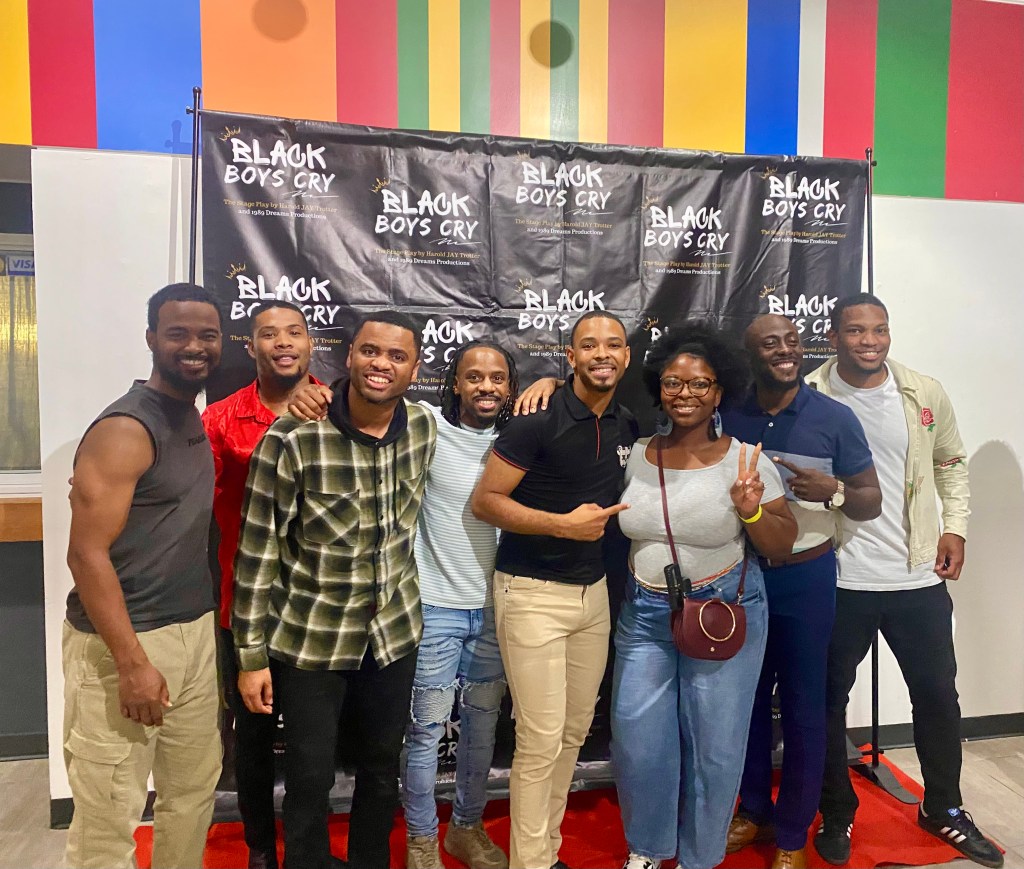
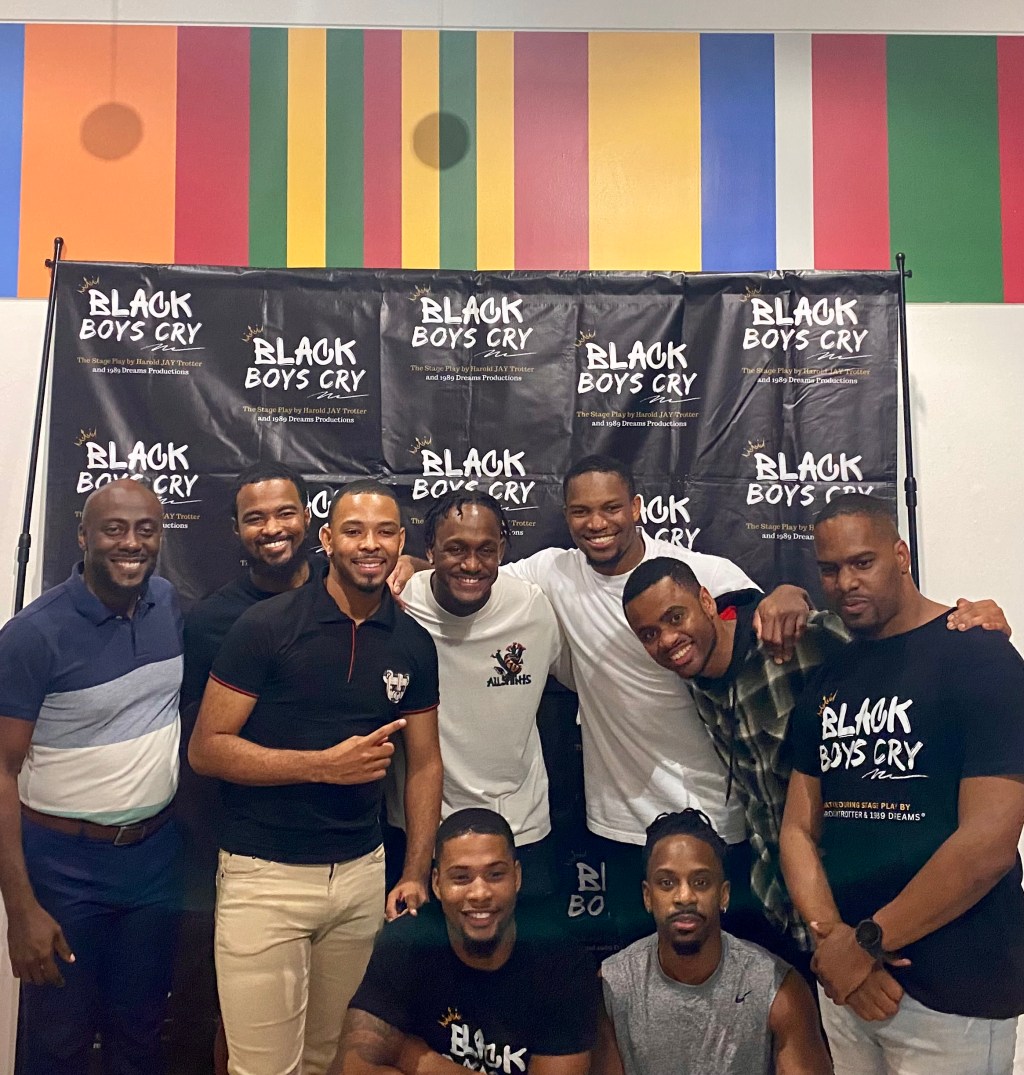
That was one of the questions I posed to the cast as well, who I had the opportunity to meet right after the show. I asked them how the experience of leaning into the stories of these fictitious men affected how they leaned into the realities of their own lives.
Their responses were beautiful and expected, namely that the transformation was not limited to their characters alone, but rather hitting home in powerful and long lasting ways.
Black men in the UK vs the US and Canada
As for my thoughts and feelings about the play, much of my impression was not different from For Black Boys. I appreciate any opportunity to better understand Black men from the inside-out, and this was no different. However, I appreciated the different cultural viewpoint, namely the lives of different Black American males and what coming of age looks like for them.
I enjoyed how much of the cultural references resonated with me, including the basketball lingo, which is a reflection of the extent to which I have been Americanised by virtue of having traveled there most of my life since childhood, but also the extent to which Black American culture was exported to us in the UK.
However, I do wonder how it was received by Black Canadian men who saw the play because that is a cultural perspective that I am not very familiar with. My time in Canada thus far makes me wonder if Black Toronto had a hybrid American-British infused cultural upbringing since that’s the impression I get from interacting with them now. I was taken aback by how similar Black Toronto culture is to Black London.
In any case, I think there is more that unites than divides us when it comes to the Black diaspora in the Western world. I don’t doubt that Black men all around will find something that hits home in the scenes of this show.
My personal checkpoints
Watching this production reminded me of For Black Boys, which Trotter cites as an inspiration for Black Boys Cry. And I’m glad he took up the mantle to make the core premise find new expression. It was good to see Black boys depicted again in their reality across the pond.
Even more, it was a critical check-in point for me to reflect on how far I have come in holding space for the nuances of Black men since I saw For Black Boys all those years ago in April 2023.
Life has changed a lot since then. From navigating the grief of the loss of my father to overcoming disappointment and heartache in relationships, I have had ample reason to ponder my relationship to and with Black men.
I have had plenty reason to sit with my attitudes, assumptions and acknowledgements. Have I done this perfectly? No. Have I done this consistently? Also no. But am I doing it with continuity? Absolutely, yes.
I have had to work through my own inner child wounds, learn to make peace with the abrupt ending of the new relationship I was forming with my father, the reconciliation of the man I knew with the information about his boyhood coming to light after the fact, which made me see him as more person than parent.
I have had to navigate difficult conversations and unwanted outcomes in relationship with Black men, friendly and otherwise, taking into account that they showed up as they did based on the tools they had, just as I showed up as I did based on the tools I had.
I have had to pause and collect myself, to hold back and reassess perspective, to be brave and speak life where there is no guarantee of return. I have had to do it all in these past three years.
And I’m better for it. Grateful for it.
And this show was the checkpoint I needed to remind me of my progress and to encourage me to keep going and keep growing.
Beyond the stage
I’ve had the conversations.
I have taken up the challenge.
And I have drawn near and held space for the strength and vulnerability that meet in Black men.
Black boys do, indeed, cry. And I’m grateful for reminders that there is no shame in that. In fact, there can be great glory and triumph in that.
As the play ended with each man speaking affirmations and declarations over himself with gentleness and accountability, I can only pray that the men who see this show feel empowered and embalmed enough to emerge with the same power and rehabilitation.
You are capable of coming to terms with who you’ve been.
You are worthy of the opportunity to start afresh.
You are capable of being better than you’ve been.
You are worthy of the journey it takes to get there.
And you will find love, forgiveness and acceptance along the way from those of us who are doing the work on ourselves to exhibit patience with you on the journey.
You can do it, Black man, I believe in you. And many others do, too…

Leave a Reply